

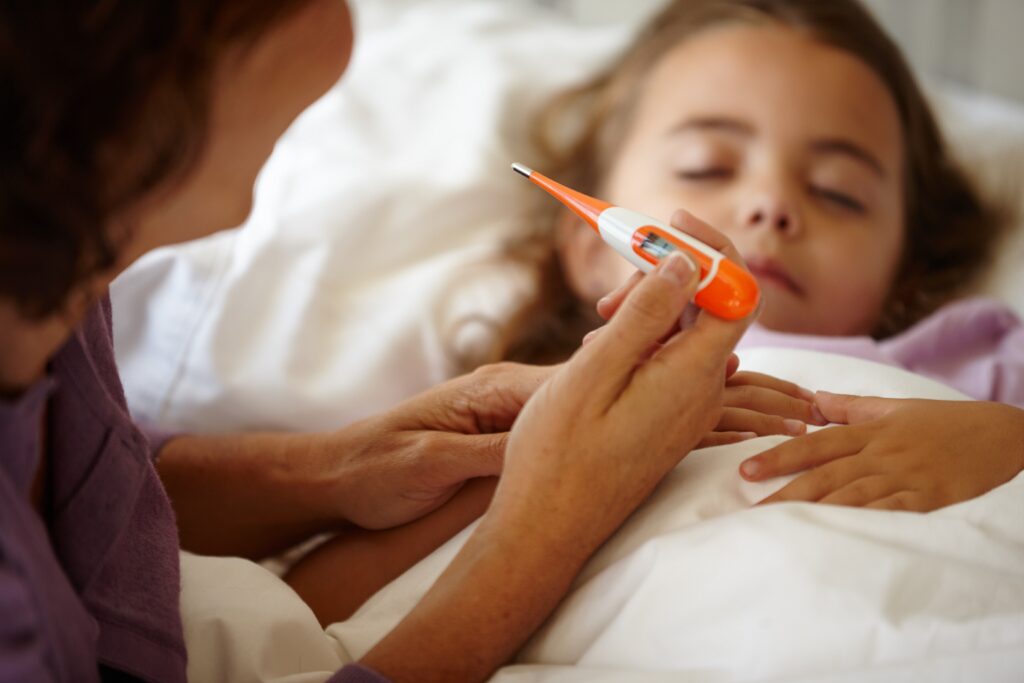
You know your own child; when they seem unusually quiet or uncomfortable, you notice. Add a temperature of 100.4 degrees or higher, and it’s natural to feel concerned.
Fever is common in children, but not every fever should be treated the same way. Age, symptoms, and behavioral changes all help you determine whether your child should go to Victoria ER.
At Victoria ER, children are typically seen within five minutes or less by board-certified ER physicians in a full-service, 24/7 emergency room built with families in mind. If your child has a fever and something doesn’t feel right, here’s how to know it’s time to bring them to Victoria ER.
Understanding fever in children: What’s normal and what isn’t
Fever can look different from child to child. One child may still want to play, while another may seem tired, clingy, or not like themselves at all. That’s why it’s important to understand both the temperature itself and the bigger picture.
What counts as a fever in children?
According to the Centers for Disease Control and Prevention (CDC), children child has a fever when their body temperature reaches 100.4 degrees or higher. But as simple as that sounds, fevers are hard to interpret.
Two children with identical thermometer readings may need completely different levels of care, depending on their age, normal behavior, and medical history. How your child acts matters more than what the thermometer says.
How the body uses fever to fight infection
The body doesn’t view fever as an enemy. Your child’s immune system uses higher temperatures intelligently to combat harmful viruses and bacteria. Simply “bringing the fever down” may not be the best first response. Instead, consider an emergency care evaluation for any fever that concerns you; it may signal an underlying condition that requires professional treatment.
Warning signs: Fever symptoms that require care at Victoria ER
Fevers can come on quickly, but how your child responds to them determines our response. Changes in behavior, energy level, or comfort can point to something more serious.
Fever temperatures that signal an emergency
Temperature can give you helpful information, but it shouldn’t be the only factor you consider. Bring your child to Victoria ER if they have a fever.
Danger signs beyond just temperature
Temperature is only one part of the picture. While some kids tolerate a fever well, others present with signs of a more severe condition. You should bring your child to Victoria ER if you notice:
- Breathing changes or labored breathing
- Persistent vomiting or inability to keep fluids down
- Severe neck pain or stiffness
- Sensitivity to light
- Rash that spreads quickly
- Lethargy or difficulty waking
- Signs of dehydration
Even if the fever number doesn’t seem extreme at first, these symptoms warrant emergency evaluation.
Fever with rash, stiff neck, or seizure: Go to the Victoria ER now
Certain combinations of symptoms raise greater concern than just fever alone. According to the CDC, a fever paired with a spreading rash, neck stiffness, light sensitivity, or a severe headache can point to a more serious infection.
If your child has a seizure during a fever, stay calm and lay them on their side in a safe area. Once the seizure passes, bring them to Victoria ER for emergency attention.
Age-specific fever guidelines for parents
Fever can mean different things depending on your child’s age. Younger children, especially infants, are more vulnerable to serious infections, which is why the same temperature can require a different response at each stage.
Newborns and infants under 3 months
A temperature of 100.4 degrees or higher in this age group requires immediate medical evaluation, even if your baby appears comfortable. At this age, a fever can be one of the earliest signs of a serious infection.
Toddlers aged 3 months to 3 years
Although fevers are often linked to common viral illnesses in toddlers, they’re still signs that your child needs emergency evaluation. Even at lower temperatures, behavioral changes make a difference. If your toddler isn’t drinking fluids or seems difficult to comfort, it’s appropriate to bring them to Victoria ER.
School-aged children 3 years and older
In school-aged children, fever is something most parents will encounter at some point. Any fever can be a reason to seek emergency care if you want clarity on what’s causing it. Victoria ER is open 24/7 with no appointment needed, and our experienced board-certified ER physicians will see your child in five minutes or less.
Seasonal tips: Fever risks to watch for this summer
Summer often brings more time outdoors and group activities, all of which can increase your child’s exposure to bacteria and viruses. Fever can show up quickly during this time of year.
Heat-related illness versus true fever in kids
Spending time outdoors in high temperatures can raise your child’s body temperature, especially during prolonged activity. A fever caused by infection, however, comes from within the body and doesn’t improve simply by cooling down.
If your child’s temperature remains elevated after enough rest and hydration, it’s important to have them evaluated at Victoria ER.
Back-to-school season and increased infection risk
The return to school means more time in classrooms, with shared environments that spread illness easily. Fever is a common early indicator that your child may have caught something.
What happens when you bring your child to Victoria ER for a fever
Victoria ER’s board-certified ER physicians see children in five minutes or less. Our focus is on thorough evaluation and straightforward answers.
Fast pediatric triage and evaluation
From the moment you arrive, your child receives a timely evaluation in a calm, supportive pediatric emergency care setting. We design each step to provide clarity and direction without unnecessary delays.
On-site lab tests and imaging for accurate diagnoses
Victoria ER offers in-house lab services and imaging, allowing for fast, accurate diagnosis during your visit.
If your child has a fever, bring them to Victoria ER for clear answers.
FAQs: Child fever and emergency care
At what temperature should I take my child to the ER for a fever?
Victoria ER can evaluate any fever, even in the early stages. You don’t have to wait for the temperature to increase or symptoms to get worse.
Can a fever cause brain damage in children?
Most fevers in children don’t cause brain damage. Fever is a natural response to infection, and the level of illness depends more on the underlying cause than the temperature itself.
What should I do while waiting to go to the ER?
Focus on comfort and hydration as you get ready to leave. Light clothing and fluids can help keep you and your child relaxed in the meantime.
How long does a fever last in children before it’s concerning?
Most fevers improve within a few days. Victoria ER is here to evaluate your child with a fever by our experienced ER physicians 24/7, even on holidays and weekends.
Is Victoria ER equipped to treat infants and toddlers?
Yes, Victoria ER is fully equipped to care for infants and toddlers. We offer prompt evaluation and access to advanced testing in one location.